Whitley Penn Talks: 2026 Healthcare Trends - AI, Compliance, & Succession Planning
Whitley Penn Talks: 2026 Healthcare Trends - AI, Compliance, & Succession Planning
12/04/2025
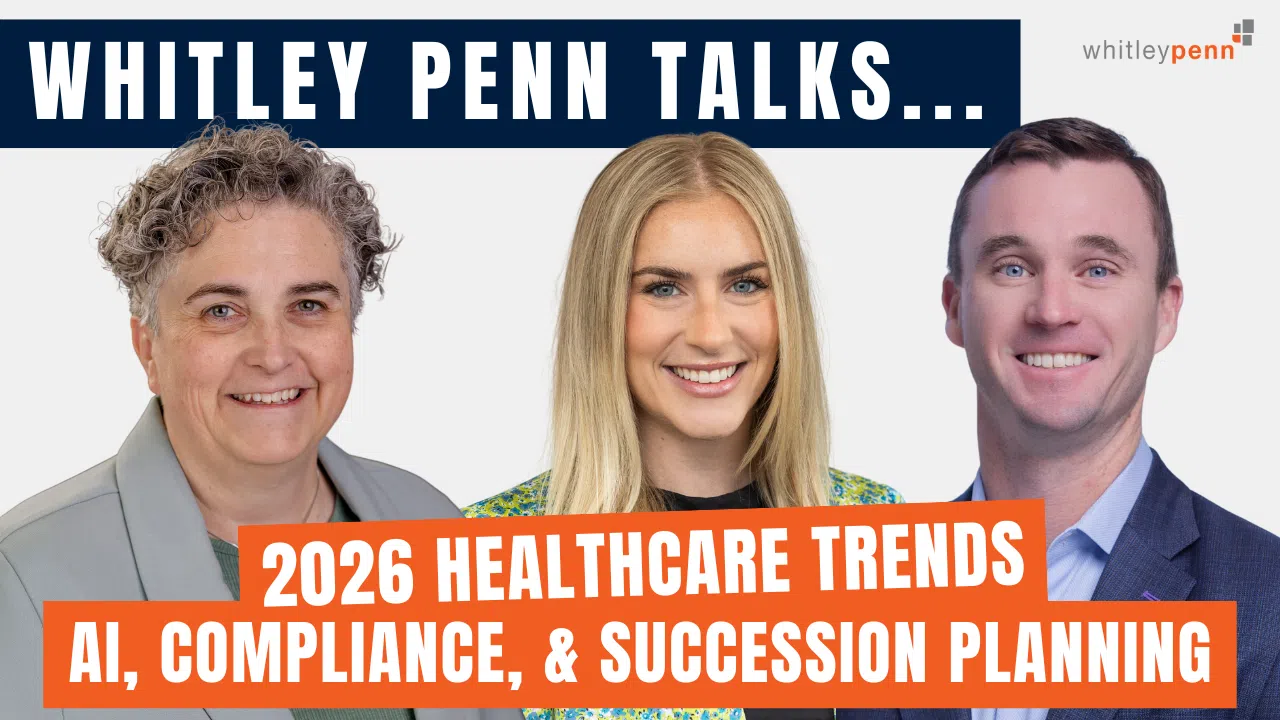
Join Whitley Penn’s healthcare leaders as they recap key takeaways from our recent Dallas Healthcare Conference. In this episode, we dive into the biggest challenges facing the industry, workforce shortages, AI adoption and security, compliance crackdowns, and succession planning for private practices. Learn how these trends will shape healthcare in 2026 and what you can do to stay ahead.
Topics Discussed:
- Key insights from panels on revenue cycle management, compliance, and leadership trends
- Top Industry Challenges for 2026
- Compliance & AI Impact
Listen to this episode on Spotify or Apple Podcasts. Click here to view the episode transcript.

12/04/2025
Join Whitley Penn’s healthcare leaders as they recap key takeaways from our recent Dallas Healthcare Conference. In this episode, we dive into the biggest challenges facing the industry, workforce shortages, AI adoption and security, compliance crackdowns, and succession planning for private practices. Learn how these trends will shape healthcare in 2026 and what you can do to stay ahead.
Topics Discussed:
- Key insights from panels on revenue cycle management, compliance, and leadership trends
- Top Industry Challenges for 2026
- Compliance & AI Impact
Listen to this episode on Spotify or Apple Podcasts. Click here to view the episode transcript.



Get new episodes straight to your inbox
Get new episodes straight to your inbox
You might also enjoy...
Episode Transcript
Kendall Neukomm (00:00)
Hello everyone and welcome to Whitley Penn Talks, where we give you valuable insights to help you make confident informed decisions and move your business forward. My name is Kendall Neukomm and today we’re back with our healthcare industry leaders to give highlights of our recent healthcare conference that we hosted in Dallas on November 13th. We’re also here to answer some of your questions that we received live at the conference, but I’d like to welcome my two guests today. have Jolie and Josh joining us from our healthcare industry team. Welcome you guys.
Jolee & Josh (00:37)
Thank you. Hello. Appreciate you guys being here.
Kendall Neukomm (00:39)
Awesome.
For sure, and Jolee, we had you just a few episodes ago, so I’m sure that listeners are familiar, but if you won’t mind, will you give a quick intro on your background before we get started?
Jolee & Josh (00:52)
Sure. I’m Jolee Patnaude. I’m with Whitley Penn RCM advisory. So I’ve been doing healthcare revenue cycle management for about 25 plus years and mainly billing and coding. But ⁓ I do the advisory part for everything from patient access all the way to collections.
Kendall Neukomm (01:16)
It’s important. And we’ve got Josh Agren here as well. Josh, welcome. Thanks.
Jolee & Josh (01:21)
Thank you. Yeah, this is my second podcast. First one was probably five years ago. You know, times have changed, you know, things are different. But yeah, I’m Josh Agren, healthcare practice leader in the Fort Worth office here. Been at Whitley Penn for 17 years and brought on Jolee about a year ago to help our clients with basically their number one issue in the healthcare world, which is revenue cycle and billing and collecting. I think it’s pretty important concept of the healthcare world.
Billing and collections, right? You do the billing part, but you also do the collection part. And you can be good at one and not the other, and that’s also bad. So you’ve to be good at billing and collecting. You have to keep your cash flow going.
Kendall Neukomm (01:58)
Yes, absolutely, absolutely. Well, very excited to dive in today with both of you. And I know we’ve got a lot to talk about, but I think to begin, we can do a quick summary of our healthcare conference. So that did happen on November 13th, just a couple of weeks ago in Dallas. And I think it was a great turnout. What would you both say?
Jolee & Josh (02:19)
Yeah, I think there was, it was a really good crowd. We had a really good RCM panel. So we’ve got lots of feedback as far as from people going, this was really good information and we hope you guys do this again next year or even more. So ⁓ we will definitely be doing that again. Yeah, I think what we’re trying to do is give content, right, to the folks that are out there. So Jolee, the RCM panel, she ran that one. We had a legal regulatory update panel with some really good folks, you know, around the DFW Metroplex. Had an M&A transaction advisory panel with, you know, investment banks, ⁓ you know, with some family office guys and some providers out there in the lending world. And we had a, you know, basically a CEO panel, leadership panel. ⁓ So kind of good content. Everybody had great things to say. So we just build the momentum, keep it going. I think we had 120 people sign up. So we’re going to double that next year.
Kendall Neukomm (03:16)
Yeah, that’s the goal. Constant improvement there. Really proud of how that one turned out and looking forward to the next for sure. So if you’re listening to this and you joined us a couple of weeks ago in person, we’re thankful that you were able to be there. And if you’re listening to this and you weren’t, we hope that you join us for the next. Definitely. Now, kind of diving into more of our topic for this episode where we’re recapping that conference and running through some frequently asked questions that both Josh and Jolee received during the conference. So to start, I think just in general, everyone is pretty curious on what major challenges we’re expecting for the future of the healthcare industry and kind of how that will all shake down over the next few years. So what are your thoughts there?
Jolee & Josh (04:04)
So overall, the biggest question that did come up quite a few times during the conference even was workforce. So even between the business side and the clinicians, there’s a really big question as to how well we’re going to be able to keep going with this.
We still have doctors coming in, still have nurses coming in, but the numbers have dropped. Also on the business side, the skill sets aren’t always there. The training is kind of specific to that area or service line. So there’s a lot of gaps that are going on. And of course, we’re kind of concerned about burnout. That is, as we know from 2020, that’s a big thing. So overall, I think one of the biggest things was workforce shortages.
Also the AI security and how AI is going to function in healthcare. There’s a lot of question as to how they’re gonna apply it. There’s a lot of concern just due to the fact that you are using patient information and you’re, a lot of people are just plugging it into AI and you should not do that because that is basically just on the internet. So you should have a specific AI to your facility or provider that is secure. Cause you are still dealing with PHI or patient health information. So this is something that a lot of people did talk about, but AI is coming and I think it’s going to be a really good tool as long as it’s applied correctly and not used significantly or independently.
So if it’s used with a person making sure that things are going through correctly and being used properly, I think that’s going to be the key. Yeah, automation for sure. I mean, think AI is obviously here. I think there’s attempts, there’s some of the big providers are trying to use it and kind of throw it in there. If anybody tells you they’re really good with AI tools in the healthcare world, I think that, you know, I got something else I can sell them too. But like there’s, I would say generally there’s, it’s new and people are trying to figure it out. And I think the automation side, especially for us, we’re using some of the automation tools, but ultimately, you know, nobody’s great at it yet. A lot of people are messing up and we would like to see other, everyone else mess up so we can make sure that if we utilize it the right way going forward.
But also the Jolee’s point, you know, you talk about the burnout and the healthcare side and you talk about the, the way, you know, things have changed. Jon Karp’s panel, you know, couple weeks ago, the CEO panel, leadership panel talked about the change in healthcare, right? 20 years ago, you get a broken arm, what do do? You go to the emergency room, right? And now you have surgery centers and now you have orthopedic centers and you have all these standalone ERs, right? And the service model is wildly different than it was 20 years ago. And so those are all things that are changing. you know, getting back to the burnout point, like part here, the doctors, struggle to find what their exit strategy, right? Where do they go, right? lot of private practice was a thing, right?
And then it’s okay, now you join a hospital, that way you don’t have to deal with anything, you just go be a doctor. And if you have a private practice, how do you exit that private practice? And so we’re kind of helping our clients understand that and what that looks like. And to get them a pipeline of physicians to take over the practice over time is a struggle. We’ve seen doctors just walk away from practices and not sell it and not give it to anybody or not transition the patient. So I mean, those are things that are happening and we want to help our clients make sure that they get that all planned out for the future.
And the critical access out there right now, because as we know lot of, especially in Texas, there’s a lot of rural hospitals. So due to the fact that with the OBBA passing, which is One Big Beautiful Bill. So with that passing, there is that portion in there for that $50 billion, but that’s over five years and each state has to apply for that, and it depends on how their application went, how many facilities they’re having to shell the money out to and what they’re going to use it for. So there’s a lot of ifs to come and the approvals won’t come out until December 31st when CMS puts that out. So it’s going to be very interesting to see how the money gets distributed because everybody’s like, well, each state will get, you know, like a million dollars or whatever. It’s like, no, that’s not how it’s going to play out. So it’s going to be very interesting what’s going to happen as that comes and what they’re going to use the money for.
Kendall Neukomm (08:30)
Yeah, absolutely. And to the point, Josh, that you just made about transitioning private practices and the like, if I am a practicing physician, I mean, how many years in advance should I really start to think about that transition plan upon retirement?
Jolee & Josh (08:45)
Probably five years before you ask that question is generally the idea, right? Because you have to identify a physician and have them practice with you and learn the business. Takes time, and so, yeah, I would say, I don’t know, at least five years. Yeah, you have to have a really good, so you can actually do the gradual and not just go, here you go, and then walk out the door. I mean, that’s not workable.
So, I believe that’s what three to five years is what most of them were saying that would be the best way to do it. The longer the better because then you can do a really good handoff and you’re still making money in that process. So you’re not just like cut off and then that’s it. So it’s good to plan this out and I don’t know how many of them are actually doing that. Some of them are just like, yep, I’m gonna retire next year. It’s like, okay, what are you gonna do now? So yeah, it’s lot of questions. ASAP I would say. I mean, think general, it’s like any other business.
I mean, doctors are no different than any other business. Accounting firms, right? You get a manufacturer down the street here. It’s the same business, right? The ownership needs to transition whether you sell it to private equity, family office, whether you sell it to another doctor, you bring your patients to a hospital system. There’s a lot of different ways to exit. It’s just understanding what’s best for you and what’s best for your patients. And that generally is a multi-year, multifaceted answer there.
I would say typical accountant response, it depends. And the higher the specialty, right? The level of, I mean, you talk about some of these specialties that are out there where the doctors went for years and years and years and built something. I mean, it takes a lot longer to transition that depending on how specialized you are. Yeah, your patients are very loyal, so that’s something else you got to consider.
Kendall Neukomm (10:13)
Yeah, lots it depends, yeah, depends on your goals. All very interesting to think about kind of as we as we continue into the next year for sure. Have either – and this is a little bit off script of me – have either of y’all watched the show The Pit? Okay, it to your Thanksgiving list, it won a bunch of Emmys. I can’t remember what it’s on, but it’s essentially 12 episodes and each episode is an hour on an ER shift.
And it’s just how the ER manages flow throughout the shift and what that looks like. And there’s a hospital business manager, some executive at the hospital that keeps coming down and telling them that they need to speed up care and move people to higher floors, to specialty floors, and make those decisions faster. And so it was a really interesting perspective into the operations of a hospital.
Jolee & Josh (11:06)
Yeah, you bring up a good point, right? Like, there’s kind of this struggle, right? You talk about hospitals, there’s already any ownership group, right? If you’re if the physicians are kind of run by a management, you know, services organization, you know, that’s owned by private equity or something else, like, there is kind of that, you know, the doctors need to do their job, right? They need to care of the patients, but the doctors make more money the more patients they see, right, at times, depending on the structure, right? Or the more patients they see, the more they build, more money they make. And so there’s always this constant struggle.
We’ve talked to lots of doctors over the years that, you know, understand that, but also like what gets lost at times is really the patient care part. And that’s what doctors are really, really good at is taking care of the patient. And sometimes maybe, you’re leaving out to your point, the hospital executive telling them to do things faster, right? Because you don’t want to make mistakes. Number one, at all times, you have to take care of the patient, right? And so I’m interested, on The Pit – Do they have a RCM specialist? Maybe we could add a guest spotlight. We could write to Hollywood.
Kendall Neukomm (12:17)
Yeah. Maybe that’s what we’ll see in season two, yeah.
Jolee & Josh (12:41)
There you go. I got a letter in to Hollywood on that one.
Kendall Neukomm (12:44)
Awesome. Well, recommend for sure if you need a show to binge over the holidays. Moving on kind of to our next topic point here, we’ve got a couple of questions for Jolee and her specialty skill set there. So Jolee, what downstream effects have you seen across the industry as a result of the healthcare enforcement operation or the fraud attempts that we’ve been talking about?
Jolee & Josh (13:09)
So basically, the compliance has gone up. Of course, everybody’s now worried about their compliance because of all the fraud that happened. And also on the CMS OIG side, which is Officer Inspector General and Centers of Medicare and Medicaid, I can say it today. So basically, they are actually looking at lot of compliance that’s going on with a lot of these providers. So the big thing right now is to know where your compliance is. Do you have compliance, first off? There’s a lot of practices that don’t, or they think that they do, they’ll say, we need to see your process and procedures. And if you don’t have something written up, you can actually get in trouble for that. They are finding people. ⁓ It’s not even like a hesitation sometimes with some of them, depending upon the size of your practice and how negligent you’ve been about it. And if your people have no idea about what compliance is, it’s time to do some education.
So that’s the big thing right now that’s hitting a lot. They’re also reviewing and slowing down the processing of claims at this point. It’s not to the point where providers might see a huge delay in their payments, but it could come to that if they keep finding more more stuff, which they are. ⁓
So right now they’re looking at more of the claims, making sure that things are being billed correctly, that this is not a fraudulent claim and that it’s not a duplicate claim that was happening with some of the payers doing double duty when they were sending in their claims for Medicare Advantage, which is what’s part of what was kicked the fraud off. So it’s a lot of give and take going on right now behind the scenes. And I don’t think everybody really knows exactly how it’s going to flow out.
But overall, it’s slowing things down, which is going to slow your payments down. So you should always have a backup or understand how your money is going to be coming in for the next six months. Just in case they do go, we’re putting a hold on CPT 1150 or whatever. Because if that happens, you’re going to see providers be like, well, that’s my bread and butter. What am I supposed to do? So make sure that you have enough in the bank that if something does happen or your payments get slowed up by three to four weeks, your operations is still going to be fine. So that’s something that’s happening right now in real time. So that’s, and they’re looking to really crack down more on ⁓ claims processing and how things are going. And for those of you listening at home, CPT code is, is what Jolee? It’s a current procedural terminology. There you go. So it’s the code that, that, that you use for the procedure that the physician performs on, you know, on a patient.
And that’s what gets billed to the insurance company. Also I’ll throw a plug out there for Jolie’s white paper she put out several weeks ago. And we pushed that out, you put in the link or something on this thing. ⁓ And then the other thing I’ll also put a shot out too, you talk about procedures and having compliance, that’s something Jolee can, I’ll throw a plug to Jolee, she writes up SOPs for her clients and helps them out in those situations. So, need some help, you give Jolee a call. Yeah, because it’s becoming an issue.
Kendall Neukomm (16:27)
Yeah. And Jolee, what’s a good question that say a practice can’t answer a question related to compliance? What’s a question that comes to mind that you would say is sort of a yellow flag if you aren’t able to answer it?
Jolee & Josh (16:43)
Well actually the first thing that happens is if somebody walks in and is doing an audit and they say, what’s your compliance procedure?
And if somebody just looks at you like they have no idea what you’re talking about, that’s a red flag. So the compliance is basically understanding what you’re supposed to be doing, staying within the HIPAA guidelines and staying, you know, making sure that PHI stays PHI and it’s not being, you know, used or abused. So the compliance acquires for everything. I mean, from the patient calling all the way for the provider seeing them all the way to the back end.
Everything has to be where it’s supposed to be and how it’s, you know, the processes are supposed to be done in a specific manner. So everybody does it a little bit differently, I’m not going to lie about that, but you still, there’s wiggle room, but you still have to stay within those guidelines. So you need to make sure that you’re staying within those guidelines.
Kendall Neukomm (17:36)
Yeah, definitely. And have documentation accordingly, I would assume as well. Yeah, definitely. Well, our last kind of, you know, small topic here today is ⁓ going to be diving back into AI. So we mentioned at the beginning of this episode, a little bit about some of the implications that AI have brought into the healthcare space. But how are how are insurance payers using AI and what does that look like currently?
Jolee & Josh (17:39)
Yes.
So the payers initiated the AI when it first became really big. Everybody was using it, like the keywords. And initiating it basically caused a huge bump of denials. They actually were up to like 33 % of denial increase. ⁓ it is out there. It’s documented that UHC and Blue Cross were the ones that when they released the AI, it automatically just started denying all the claims because they have aggressively put their algorithm in there that it’s supposed to look for specific things and it’s on an automatic denial.
So that has been, I’m not going to say totally pulled back, but they have kind of pulled it back a bit. And they’re reviewing their algorithm or changing it or modifying it, however you’d like to see that. But it’s still incorporated into the process. So overall, these things are still happening. since 2020, do believe it’s, yeah, it’s gone up, denials have gone up over 25% just year after year they just keep going up and right now they’re 25 % higher than they were in 2020.
So again, you know, they’re just being aggressive of not processing claims. And that hurts the providers, which then can’t give patient care because either they can’t get supplies or they can’t keep people. I mean, it’s just a domino effect or a snowball effect. I mean, it’s going to happen because you’re not having your revenue coming correctly. And I think that it just amazes me that the payers still make it so difficult. And yet the providers have to follow all these rules and all these regulations, but the payers do not.
It’s kind of so one-sided, it’s not even fair. And I’m like, is it health care or is it corporation? So which is it? You have to do that balancing act. And I don’t think it’s happening enough. So again, I can go on and on, but I’m not going to. And I think, like I said earlier on this deal, if anybody’s saying they’re really good at implementing AI, I think that’s a stretch and I think that’s something we got to our eyes on. And I’ll throw another plug out to Jolee, if you don’t have a proper denials management process and if you’re not properly addressing your denials and you’re getting paid, that’s when you call Jolee. Yeah, always look at your contracts and make sure you’re getting paid correctly.
That’s what we can do for you. So we can go in and do a complete audit. We can look at your processes, both billing and coding. I’m certified in coding, so I could do a coding audit for you also. You’d be amazed at somebody, how many, it’s like you say, when was your last coding audit? And they just go, have we ever had one? So I mean, it’s literally a thing and people don’t understand that, especially the smaller practices. They don’t think about it. And that can come back to bite you because in some cases, if CMS shows up or something like that, some of the first things they ask you is, when was your last time you had a billing audit or a coding audit? So these things do happen. And I don’t think people really understand that they’re taking this very seriously right now. And they will start showing up at different doors. And I don’t know if everybody’s ready.
Kendall Neukomm (21:14)
Right. And I mean, to bring this somewhat full circle to the beginning of the conversation to succession planning and making sure that your practices is able to be succeeded at the end of the day. ⁓ I would imagine that making sure all of these processes and procedures and compliance documentation has been done along the way to make that transition even more successful. Would we agree with that?
Jolee & Josh (21:44)
Yeah. That’s it.
Kendall Neukomm (21:47)
Awesome. Yeah, awesome. Well, thank you both so much for your time. I think that that’s pretty much what we were hoping to uncover today on this episode. And Jolee, I know this is your second, so Josh, we’ll have you back for a second in the next few episodes, I’m sure. But thank you both again. This has all been extremely helpful. Again, if you’re out there listening and you did not attend our healthcare conference this November, make sure that you do join us for the next. We can link Jolee’s white paper in the comments of this episode. So if you’re listening again, it’ll be linked below. And if you enjoyed today’s episode, be sure to subscribe on YouTube, Spotify, Apple, or listen right on our website at willypin.com slash podcasts. If you’re interested in receiving our episodes straight to your inbox, along with other industry updates like white papers, events, et cetera, check the link in the description as well to sign up for our email list.
Truly thank you both and we hope everyone has a great rest of your day.
Jolee & Josh (22:44)
Thanks, you too. Thanks.